
Under the hoodLOCRAI team12 min read
OCR and AI for documents: from scanned text to structured data
Document OCR and AI are not the same thing. A guide to the two layers of intelligent document processing: when text recognition is enough, and when AI must interpret layout and fields.
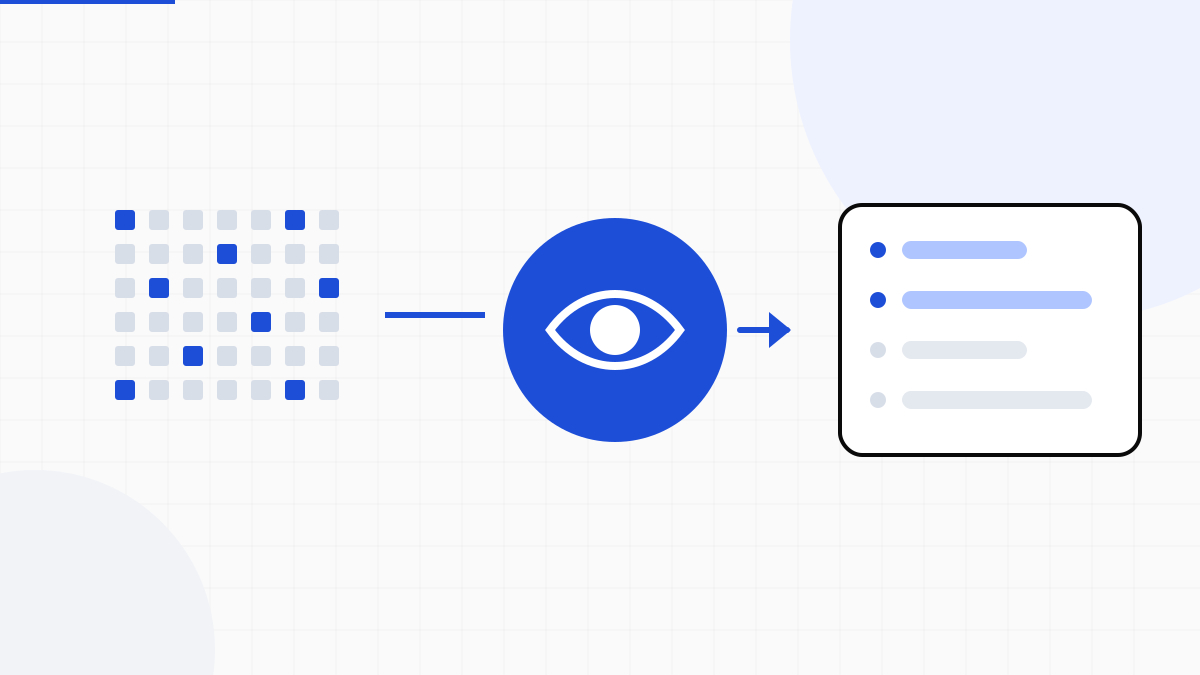
In marketing materials, «OCR» and «artificial intelligence» often appear in the same sentence, as if they were a single indivisible block. In reality they are two distinct layers: the first turns an image into characters, the second interprets those characters (and the layout) to produce structured data. Confusing them leads to wrong expectations — and to paying for AI where much less would suffice.
If you handle invoices, delivery notes or orders at scale, understanding where OCR ends and AI begins helps you evaluate vendors, estimate costs, and see why some documents pass on the first try while others land in review.
OCR for AI training vs OCR for business documents
OCR for AI training is usually a dataset-preparation task: converting scanned books, labels or forms into text used to train or evaluate a model. Document OCR has a different operational goal. It reads invoices, delivery notes and orders, then an AI layer maps the content to fields and line items that an ERP can use. LOCRAI focuses on this second workflow; it is not a dataset-labelling or model-training service.
What OCR actually is
OCR (Optical Character Recognition) reads the pixels of an image and returns text: a string of characters, line by line, without knowing that sequence is an amount, a VAT code or the supplier's company name. It works well on straight text, sufficient contrast and adequate resolution. On native digital PDFs it is often unnecessary: the text is already in the file.
- Strengths: speed, low cost per page, repeatable results on stable layouts
- Limits: no semantic understanding — «1,234.56» and «1234.56» are two different strings to reconcile later
- Quality-sensitive: skewed scans, stamps over numbers, tight tables degrade output
What artificial intelligence adds
The AI layer — today often multimodal models or document understanding pipelines — does not stop at reading characters. It maps text blocks to fields (supplier, date, total, line items), handles unseen layouts, recovers broken tables and flags anomalies (totals that do not match line items). It is more flexible than OCR alone, but also costlier and less deterministic: that is why it makes sense only where OCR is not enough.
When OCR is enough — and when it is not
- OCR (or text layer) sufficient: digital PDFs from ERP systems, fixed layout, fields always in the same places
- AI or smart rules needed: many different suppliers, variable scan quality, complex tables, documents never seen before
- Human review needed: stamps on amounts, illegible documents, contractual exceptions outside the schema
OCR answers «what is written?». AI answers «what does it mean, and which field does it belong to?».
OCR + AI: the sensible combination
A good system does not apply AI to everything. It follows a cascade: native document structure, text layer, OCR, then AI interpretation only where needed. Average cost stays manageable and timing predictable even with a mix of digital PDFs and scans. Always ask the vendor how it classifies your documents and which layer it uses for each type.
LOCRAI combines OCR and AI this way: progressive extraction, exception flagging and a review queue for cases no engine should force through. Less generic promises, more control over the real workflow.
Where document OCR shows up in practice
On supplier invoices and delivery notes, OCR is usually one step in a cascade — native PDF text, then OCR on scans, then AI only where layout varies. For scan quality constraints, see OCR on scans: quality and review.
Want to see it on your documents?
We'll show you LOCRAI at work on one of your real workflows, in a short, concrete demo.
Request a demo